Non-universality of the mass function: dependence on the growth rate and power spectrum shape
Jan 1, 2022· ,,,,·
0 min read
,,,,·
0 min read
Lurdes Ondaro Mallea
Raul E. Angulo
Matteo Zennaro
Sergio Contreras
Giovanni Aricò
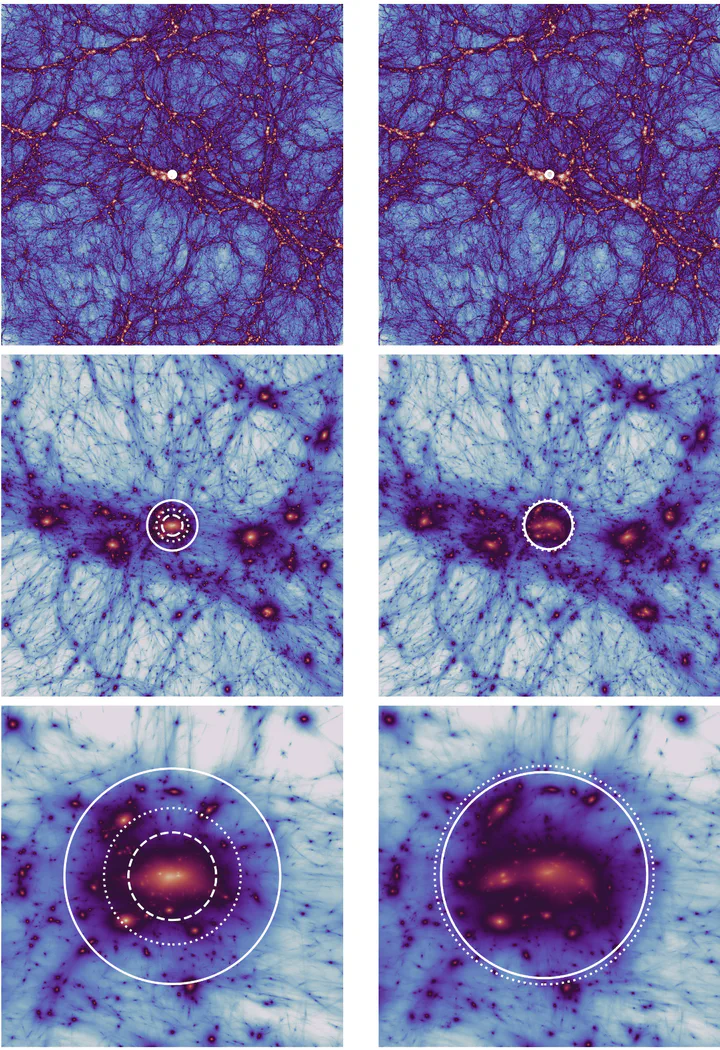 Zoom-ins of the same halo forming in two cosmologies that share the linear density field (see top row), but vary in their recent growth history. The mass assigned to the halo depends on cosmology due to 1) the slightly different density profiles and 2) cosmology dependence of halo mass definitions, illustrated in the white circles.
Abstract
The universality assumption — i.e. that the halo mass function depends solely on the linear mass variance of the density field — fails at the 10-20% level. If neglected, this could add large systematic errors in the cosmological analysis of current and future cluster counts. In this paper, we showed that the non-universality can be traced back to the way in which the same linear fluctuation grows differently into the nonlinear regime depending on details of its assembly history. We parametrise the dependence on the growth history using a single, physically motivated parameter, thus capturing both the redshift and cosmology-dependent non-universality. When applied to the cosmology-rescaling algorithms, this model predicts halo mass functions accurate at 2% in just a few second. The predicitions hold beyond LambdaCDM cosmologies, including massive neutrinos and dynamical dark energy up to z=1.
Publication
In MNRAS